

Hearing a cancer diagnosis is overwhelming, but few words carry as much weight in a consultation room as “operable” or “inoperable.” For many patients and families, these terms sound like a final verdict. They often assume that operable means cured, while inoperable means hopeless.
However, medical terminology does not always match everyday language. In modern oncology, these words describe a tumor’s current surgical status, not an outcome. Understanding what makes a cancer operable or inoperable can help you make clear, confident decisions about your care.
What "Operable" Really Means
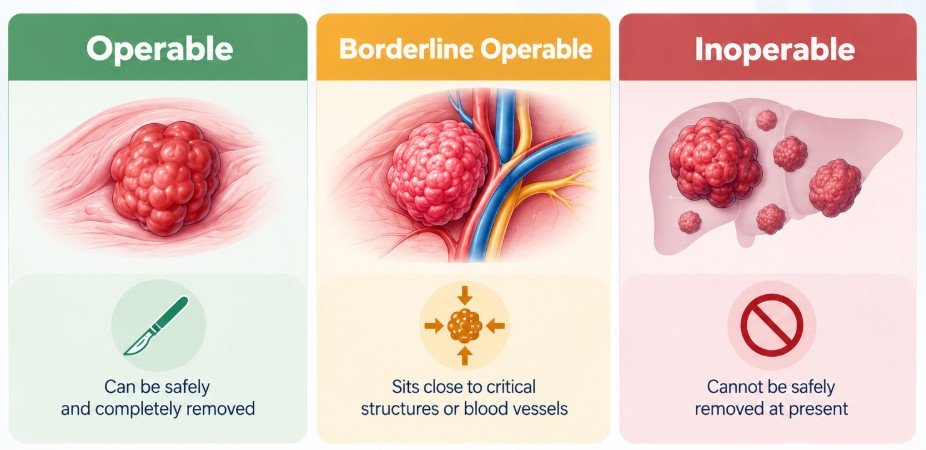
A cancer is generally considered operable, or resectable, when a surgeon can remove the tumour completely, along with a margin of healthy tissue around it, without unacceptable risk to the patient’s health or function. This depends on several factors working together:
- Size and location of the tumour – whether it can be removed without damaging critical structures nearby
- Whether it has spread – to nearby lymph nodes or distant organs
- The patient’s overall health – since surgery itself carries risk, especially for longer or more complex procedures
- Involvement of major blood vessels or organs – tumours wrapped around key structures are often harder to remove safely
Operability isn’t only about the cancer; it’s a judgment that weighs the disease against what the patient’s body can safely undergo.
What "Inoperable" Actually Means
Inoperable, or unresectable, doesn’t mean untreatable. It means that at this time, surgery alone isn’t a safe or effective option, usually because the tumour is too large, too close to vital structures, or has spread in a way that surgical removal wouldn’t meaningfully change the outcome.
This distinction gets lost in translation a lot. Patients often hear “inoperable” and assume the worst, when in reality, it’s simply information that redirects the treatment strategy rather than ending it.
Treatment Options Beyond Surgery
When surgery isn’t the immediate answer, several other approaches come into play, sometimes on their own, sometimes in combination, and sometimes as a bridge back to surgery later.
- Chemotherapy uses drugs to kill or slow the growth of cancer cells, and can shrink tumours enough to change what’s surgically possible.
- Radiation therapy targets cancer cells with focused energy, either to shrink a tumour or control disease that can’t be surgically removed.
- Targeted therapy and immunotherapy work differently from traditional chemotherapy, focusing on specific molecular features of cancer cells or helping the immune system recognize and attack them.
- Hormone therapy, relevant for certain cancers like breast and prostate, works by cutting off the hormonal signals that fuel tumour growth.
The right combination depends entirely on the cancer type, its biology, and the patient’s overall condition; there’s no one-size-fits-all sequence.
The Strategy Most Patients Haven't Heard Of
Here’s something worth understanding clearly: many cancers labeled “inoperable” at diagnosis don’t stay that way. This is where an approach called neoadjuvant therapy comes in: treatment given before surgery, specifically to shrink the tumour or downstage the disease enough to make surgical removal possible later.
This isn’t a backup plan or a consolation prize. In several cancers – breast, lung, and pancreatic cancer, among them- neoadjuvant chemotherapy or combined treatment has become a standard, deliberate strategy precisely because it can convert a borderline or inoperable tumour into one that can be safely removed. It’s also used in some operable cancers, where shrinking the tumour first can mean a smaller, less invasive surgery than would otherwise be needed.
The reassessment doesn’t happen just once. Oncology teams typically re-evaluate operability at multiple points, before treatment, partway through, and again once neoadjuvant therapy is complete, because a tumour’s response to treatment can genuinely change what’s possible surgically.
Why the Full Picture Matters
An “inoperable” label at diagnosis is a starting point, not a final verdict. It reflects where things stand today, based on the information available right now, not necessarily where things will stand after treatment begins. Which is why treatment planning for complex cancers works best as a team effort between surgeons, medical oncologists, and radiation oncologists, rather than a single specialist making the call in isolation.
A few questions worth asking your care team if you’ve heard the word “inoperable”:
- Is this inoperable now, or inoperable in general, and could that change with treatment?
- What’s the specific goal of the recommended treatment, shrinking the tumour, controlling growth, or something else?
- When will operability be reassessed?
We Look at the Whole Picture, Not Just the First Answer
Determining whether a cancer is operable isn’t a single decision made in isolation; it’s an ongoing evaluation that considers the tumour, the patient, and how the disease responds to treatment over time. As a surgical oncology practice in Mumbai with over 14 years of experience across breast, thyroid, colorectal, and other complex cancers, we work closely with medical and radiation oncology teams to give every patient the most accurate, complete picture of their options.
If you or a loved one have been told a cancer is inoperable and want a thorough second opinion on what’s genuinely possible, book a consultation with us at our Dadar or Matunga clinic. Every case deserves a full evaluation before any door is considered closed.
Disclaimer: This article is for informational and educational purposes only and should not replace professional medical advice, diagnosis, or treatment. Always consult a qualified healthcare professional regarding any medical condition.