
Patients may hear terms such as laparoscopic surgery and robotic-assisted surgery when discussing cancer treatment. Both use small incisions, a camera, and specialised instruments. The main difference is how the surgeon controls the instruments. Neither method is automatically better for every cancer. The priority is appropriate tumour removal and a method suited to the patient.
Can Cancer Be Removed Safely Through Minimally Invasive Surgery
In the video, Dr. Sanket Shah, an experienced oncologist in Mumbai, addresses whether laparoscopic or robotic surgery can be used for cancer. He explains that these approaches were once avoided in some cancer operations because of concerns about incomplete tumour removal or rupture, which could allow cancer cells to spill.
He discusses how improved instruments and techniques have expanded their use in selected cases, along with possible benefits such as less pain and faster recovery. Suitability still depends on the cancer and the operation.
What Is Laparoscopic Cancer Surgery?
In laparoscopic surgery, the surgeon makes a few small incisions and inserts a thin camera, called a laparoscope, through one of them. The camera displays the operating area on a monitor. The surgeon watches this view and moves long, narrow instruments through the other incisions to operate.
It allows the surgeon to work through small incisions rather than the larger incision used in conventional open surgery.
What Is Robotic-Assisted Cancer Surgery?
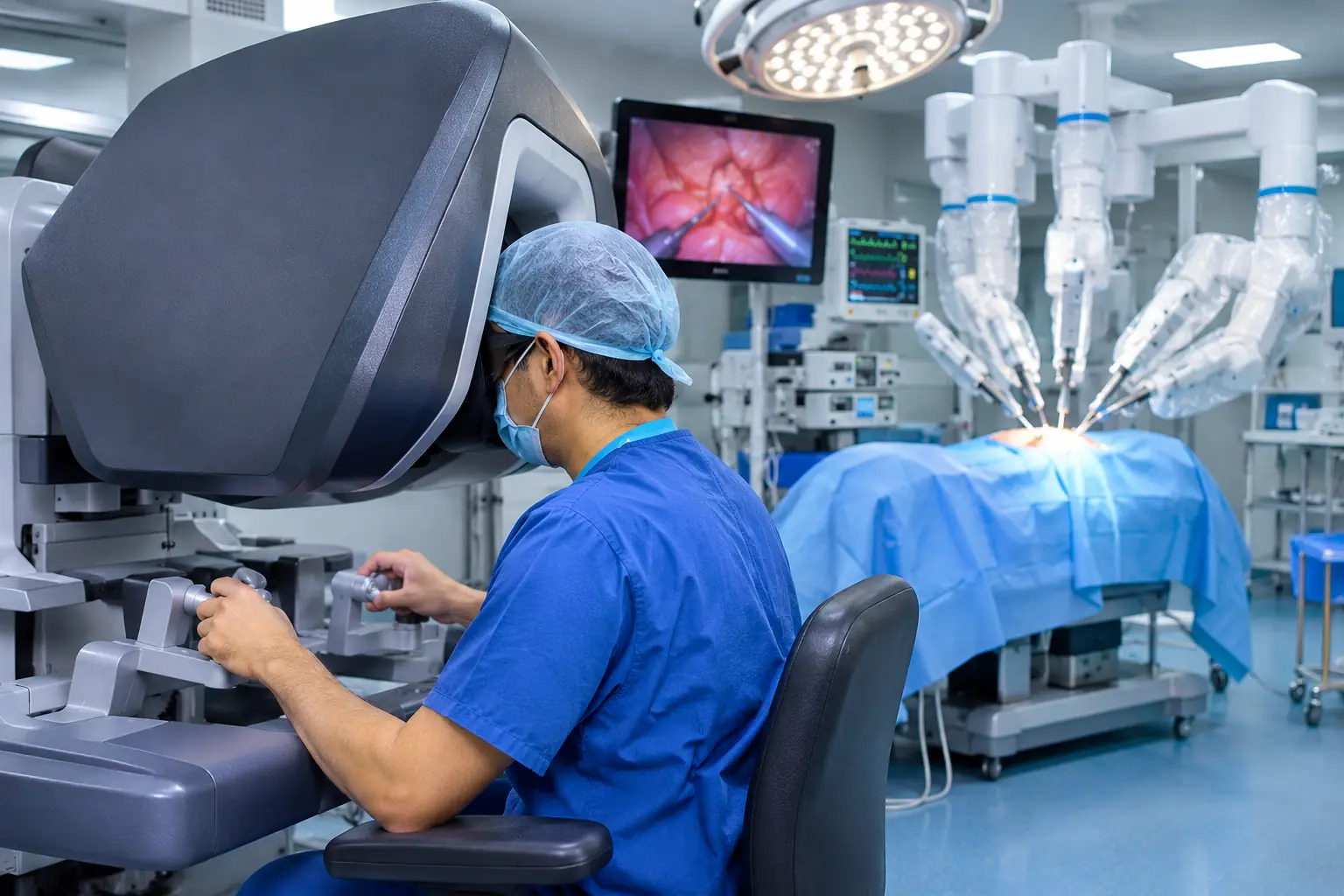
Robotic-assisted surgery also uses small incisions, a camera, and instruments. The surgeon sits at a console and controls the robotic arms. The system can provide a magnified 3D view and instruments with wrist-like movement for work in confined spaces.
The word “robotic” can be misleading. The system does not operate independently or make decisions. The surgeon controls the instruments throughout the procedure.
Robotic vs Laparoscopic Surgery: Key Differences
Both approaches aim to operate through smaller incisions. Their practical differences include:
| Feature | Laparoscopic surgery | Robotic-assisted surgery |
|---|---|---|
| Instrument control | Surgeon directly handles long instruments | Surgeon controls instruments from a console |
| View | Camera image on a monitor, often 2D or 3D depending on equipment | Usually a magnified 3D view |
| Instrument movement | Instruments have more limited movement | Wristed instruments offer a greater range of movement |
| Equipment and cost | Usually needs less specialised equipment | Requires a robotic platform and may cost more |
Robotic systems may help in technically demanding procedures, particularly in narrow spaces. However, they do not guarantee a better result. Laparoscopic surgery remains an established option for many suitable operations.
Does the Surgical Approach Affect Cancer Removal?
Cancer surgery is not simply about using the smallest incision. The surgeon must remove the tumour according to oncological principles, which may include taking a margin of surrounding tissue and assessing nearby lymph nodes.
The tumour must be handled carefully to avoid rupture or spillage, and the method used to remove it from the body matters. If complete removal is difficult through a minimally invasive approach, the surgeon may recommend or change to open surgery. This is a decision made for patient safety and cancer control.
What Are the Possible Benefits and Risks?
When appropriate for the specific cancer and operation, minimally invasive surgery may offer:
- Smaller incisions and less wound discomfort.
- Lower blood loss in some procedures.
- A shorter hospital stay or quicker return to routine activities for some patients.
These outcomes are not guaranteed. Both laparoscopic and robotic-assisted surgery carry risks such as bleeding, infection, blood clots, injury to nearby organs, complications from anaesthesia, and the possibility of needing open surgery. Robotic procedures may also take longer or cost more, depending on the operation and hospital.
Evidence varies by cancer and procedure. It does not show that robotic surgery improves survival across all cancers or is always superior to laparoscopy. The surgeon’s experience and patient selection matter.
The Most Important Question Is Not "Which Technology Is Newer?"
A newer platform does not automatically make an operation more suitable. Before deciding, patients can ask the treating team:
- Is laparoscopic, robotic-assisted, or open surgery appropriate for my cancer and its stage?
- Can the tumour be removed completely and without rupture using the proposed approach?
- What are the likely benefits, risks, recovery time, and additional costs in my case?
- How often does the surgeon perform this specific operation, and when might open surgery be needed?
Discussing the Options With Your Cancer Care Team
The right approach depends on the tumour’s size and location, nearby organs, planned surgery, the patient’s health, and the team’s experience. Biopsy reports, scans, and the overall treatment plan help determine whether robotic-assisted, laparoscopic, or open surgery is appropriate. Dr. Sanket Shah’s video explains the key differences; the treating surgical oncology team should make the final decision.
For more on the healing process after an operation, read Life After Cancer Surgery: Recovery and Follow-Up Care.